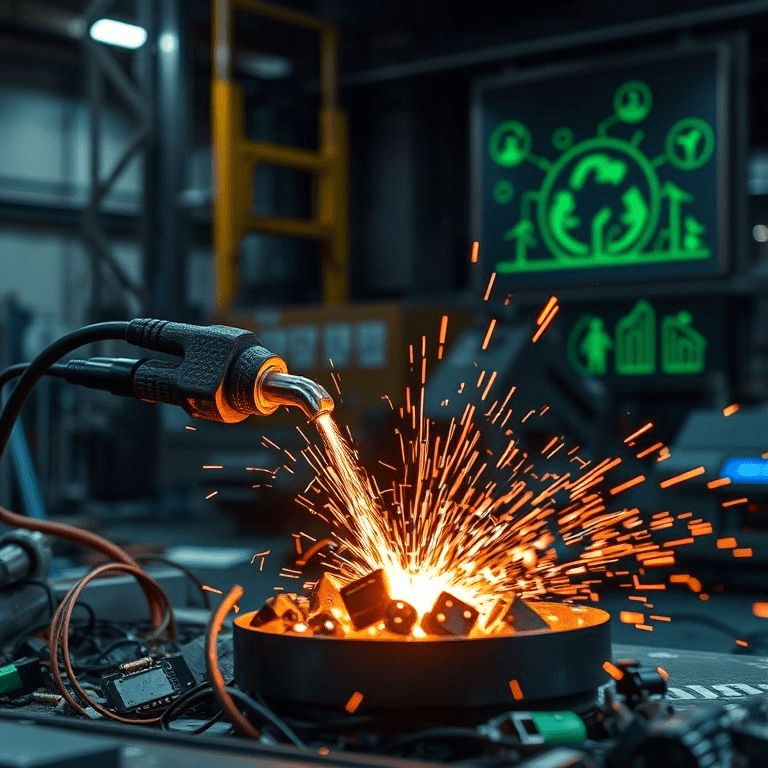

Ascend Elements Raises $300M to Transform EV Battery Recycling
The global clean energy revolution just received another boost. Ascend Elements, a U.S.-based EV battery recycling startup, has closed a $300 million funding round aimed at scaling its recycling technology and building one of the world’s largest sustainable battery material facilities.
This landmark funding, led by Decarbonization Partners (a joint venture of BlackRock and Temasek), puts Ascend Elements at the heart of the electric vehicle (EV) supply chain transformation.
The EV Battery Challenge
The surge in electric vehicle adoption has brought immense pressure on the global supply of critical minerals such as lithium, nickel, cobalt, and manganese. Extracting these materials through traditional mining is not only costly but also environmentally damaging.
Experts warn that without large-scale recycling solutions, the EV industry could face supply chain bottlenecks that jeopardize climate goals.
Ascend Elements’ mission is to address this challenge by creating a circular economy for EV batteries, ensuring old batteries become the raw material for new ones.
Inside the $300 Million Expansion Round
The $300M round included contributions from:
- Decarbonization Partners (lead).
- Fidelity Investments.
- Fifth Wall Climate Fund.
- Material Impact.
The funding will support:
- Expansion of Ascend’s flagship recycling facility in Hopkinsville, Kentucky.
- Development of new plants in Europe and Asia, where EV adoption is surging.
- R&D investment in hydro-to-cathode recycling technology.
How Ascend Elements’ Technology Works
Traditional battery recycling methods often involve smelting, which is energy-intensive and yields impure materials. Ascend Elements has pioneered a hydro-to-cathode process, which:
- Breaks down spent lithium-ion batteries into black mass.
- Extracts and purifies critical minerals.
- Directly produces cathode active materials (CAM) ready for new batteries.
This method delivers materials with higher purity than mined equivalents, reduces energy use, and lowers costs — making it attractive to automakers and battery manufacturers.
Market Impact and Industry Context
The EV market is projected to reach 40 million annual sales by 2030. By then, nearly 50% of EV battery materials may come from recycled sources. Ascend Elements is well-positioned to lead this shift.
CEO Mike O’Kronley emphasized:
“Battery recycling isn’t just about sustainability; it’s about securing the EV supply chain. Our technology ensures that we can meet demand without over-reliance on mining.”
Automaker Partnerships
Several major automakers, including General Motors, Stellantis, and Honda, are in talks with Ascend Elements to integrate recycled CAM into their future EV production lines. Such partnerships could guarantee long-term demand for Ascend’s output.
Climate and Policy Drivers
Government policies are also fueling demand:
- The U.S. Inflation Reduction Act (IRA) incentivizes domestic battery production and recycling.
- The EU Battery Directive mandates recycling quotas.
- China has also announced stricter requirements for EV battery reuse.
These policies ensure that startups like Ascend Elements benefit from both regulatory support and market demand.
Investor and Expert Commentary
Sustainability investor Rajiv Malhotra observed:
“EV battery startups are no longer niche players; they are central to the clean energy transition. Ascend Elements’ $300M raise shows how critical recycling is to the future of mobility.”
BlackRock’s sustainability division also commented that recycling technologies represent “the next frontier of climate investing.”
Future Growth and Global Outlook
With its Kentucky facility set to triple capacity, Ascend aims to:
- Expand in Europe to serve Volkswagen, BMW, and Renault.
- Launch in Asia, where BYD and other Chinese EV makers are scaling.
- Innovate with next-gen cathode technologies that improve battery performance.
By 2035, Ascend Elements could supply a significant share of global CAM demand.
Long-Term Significance
The success of Ascend Elements highlights the growing recognition that sustainability and profitability can go hand in hand. As investors pour billions into climate tech, EV battery startups are emerging as some of the most strategically important companies of the decade.